
You would be forgiven to think that an investment fund that claims to pursue “sustainable” goals would refrain from holding assets in a fossil fuel company which is significantly increasing its investments in fracking operations.
Or perhaps in a company behind a massive new oil pipeline across Uganda and Tanzania, risking the expropriation of more than 100 000 people, and the emission of an estimated 34 millions tons of CO2 every year.
Yet ExxonMobil and TotalEnergies – the two fossil fuel giants behind the environmentally disastrous projects noted above – have received over a billion euros of investments through funds with alleged “Environmental, Social and Governance” (ESG)” objectives under current EU regulations.
Loosely regulated and ideal ground for unashamed greenwashing, ESG funds are experiencing a growing popularity with many European citizens hoping to combine their investment portfolios with allegedly positive sustainability impacts. One recent study has shown that demand for funds containing ESG terms has consistently surpassed the demand for funds without these terms over the last six years. Another study by the financial data provider Morningstar found that by the end of 2023, 60% of European’s investments were held in “sustainable” funds, amounting to a staggering 5.2 trillion euros.
The latest revelation about rampant greenwashing in this financial sector comes from an investigation led by Follow the Money and Investico, which analyses the investment portfolios of 1277 European funds with “environment-related” terms in their names. Applying the latest restrictions issued by the European Securities and Markets Authority (ESMA) on terms used in ESG funds’ names, the investigation found that 4 out of 10 funds advertised as “sustainable”, contained investments in companies heavily active in the fossil fuel sector.
But whilst the new rules proposed by ESMA, the EU’s supervisory body of financial markets, are designed to limit extreme cases of greenwashing, they do not address the fundamental problem of “sustainable” investment portfolios in Europe: the almost complete absence of external regulation and oversight of this booming financial sector, which leaves asset managers free to designate funds with alleged “sustainability” objectives themselves, and adjust their marketing stratégies accordingly.
What the investigation reveals ?
In the highly technical and cryptic world of finance, most investors looking to couple their investments with sustainable outcomes, make their decision based on one simple criteria: the fund’s name. Thus, funds that contain terms such as “green”, “clean energy”, “net-zero” and other sustainability words are the go-to choices for environment-conscious investors.
With this in mind, the investigation led by Follow the Money and Investico analysed the investment portfolios of 1277 funds containing environment-related terms in their names, obtained from the database of Morningstar. According to the published methodology, the terms used for obtaining the dataset were ‘sustainability’, ‘green’, ‘ESG’, ‘climate’, ‘net zero’, ‘clean energy’ and ‘environment’,as well as their translations in German, Spanish, French, Dutch and Danish. The funds analysed contained a total of more than 298 thousand investments, worth 525 billion euros.
The investigation applied the new guidelines issued by ESMA in December 2023 – but yet to be officially adopted – which aim to halt abusive marketing practices by financial institutions active in the sector, through the introduction of a set of restrictions on “sustainable” funds’ names. Concretely, funds that contain “sustainability-related” terms will have to apply the exclusion criteria of the Paris-Aligned Benchmark (PAB), which among other measures, require the exclusion of companies that derive more than 1%, 10% and 50 % of their revenues from coal, oil and gas respectively, from investment portfolios.
Following the application of this method, the investigation found that out of the 1277 funds analysed, 551 (43%) held assets in companies that derived a significant portion of their revenues from fossil fuel activity as defined by the PAB.
TotalEnergies is the entity that has received the largest volume of investments with 1.1 billion euros of financing, but the list also includes other oil giants such as Shell, Saudi Aramco, ConocoPhillips and ExxonMobile. The financial institutions providing the largest flows to the fossil fuel sector were the American giant BlackRock and the French asset management company Amundi, with respectively 1.2 billion and 993 million euros of investments. Overall, almost 7 billion euros that were designated as ‘sustainable’ ended up flowing to companies heavily active in fossil fuel activities.
A financial market with no external supervision
Whilst the new guidelines introduce some safeguards against greenwashing practices which would have theoretically prohibited the use of “sustainable” funds to finance the above companies, they do contain notable loopholes.
One example is that the word “transition” is subject to a lower threshold of restrictions as other sustainability-related terms (PAB exclusion), since a “transition” strategy is seen as a distinct category to “sustainable” activity. Crucially, the text goes one step further and makes clear that environmental terms used in combination with “transition” will also be subject to lesser restrictions. Thus under this classification, a fund which identifies itself as contributing to “green transition” or “ecological transition” would not have to apply the restrictions to companies that derive more than 1%, 10% and 50 % of their revenues from coal, oil and gas respectively.
This example highlights the difficulty with limiting supervision to a semantic exercise whereby the use of certain terms to define the investment portfolio are prohibited or regulated. This approach may restrict the room for maneuver for asset management companies, but it still allows them to simply adjust their marketing strategies according to the new guidelines and find communication loopholes. The fundamental problem, rather, is that the nature of activities designated as “sustainable activities” are not properly defined and that there is no European framework for the external supervision and certification of what asset managers can define as “sustainable” funds.
The EU framework that regulates “ESG” funds is the Sustainable Finance Disclosure Regulation (SFDR) adopted in 2021. The regulation contains provisions on different categories of funds based on the level of “ESG” ambitions pursued, and establishes a transparency framework of oversight in line with those different categories. The higher the level of ambition, the greater the transparency obligations.
The three different categories are identified as follows:
- A financial product that does not actively pursue ESG ambitions (Article 6)
- A financial product that “promotes environmental or social “characteristics”(Article 8)
- A financial product that has “sustainable investment as its objective” (Article 9)
Therefore, the system allows asset managers to designate their financial products as “Article 8” or “Article 9”, as long as they fulfill the associated transparency requirements, but with no effective oversight and validation of their claims. In addition, the regulation provides a highly vague definition of what constitutes “sustainable investment” with no meaningful safeguards or thresholds. This means that ESG considerations can be interpreted in a variety of ways by different asset managers, with no trace of consistency and evidence of effective impact.
The ESMA guidelines which regulate the terms employed in marketing strategies, does not change the nature of the supervisory framework, nor does it provide a precise definition of what constitutes “sustainable” investment, beyond the terminology employed in the funds’ names.
Moreover, with many of the funds registered in Luxembourg, financial authorities of national governments hoping to regulate these “sustainable” funds in a more meaningful manner, will be unable to do so precisely because there is no European system of supervision and enforcement.
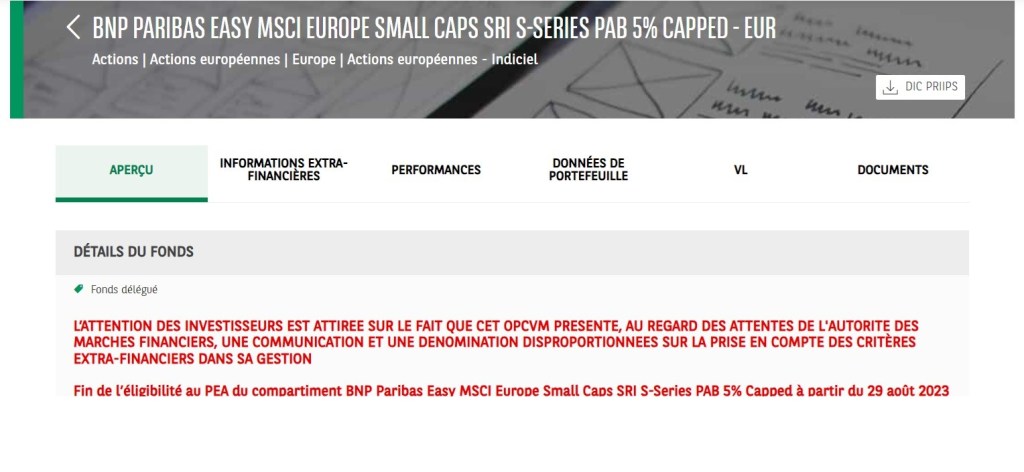
The only option left to them in such instances is to display a message pointing to insufficient and misleading information on the fund’s page, as demonstrated in the example below showing a warning message from France’s Autorité des Marchés Financiers on the website of BNP Paribas’ asset management institution.
Until these underlying flaws in EU regulation are addressed, “sustainable” funds will likely remain a fertile ground for greenwashing, with the fossil fuel sector and asset management institutions operating as the primary beneficiaries.
 International Political Economy Watch
Leave a comment